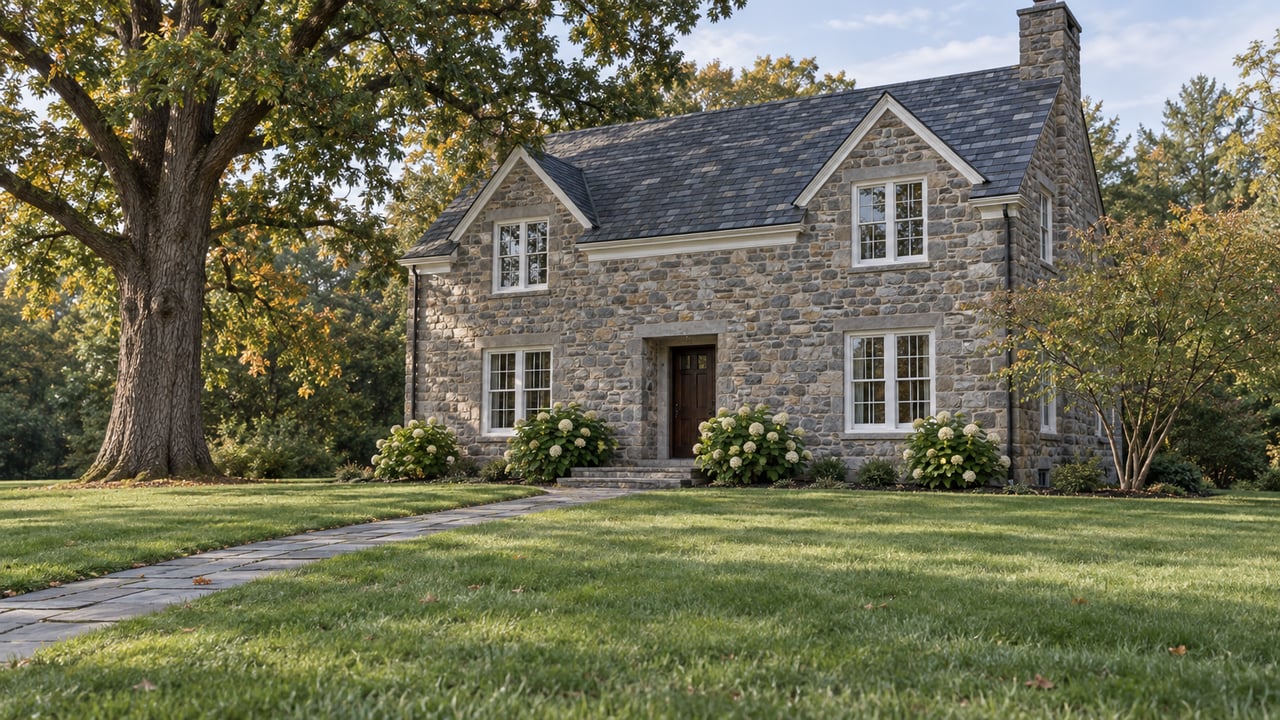
Erdenheim Farm Made the National Register This Summer. Here's What Actually Changed.
Drive down Stenton Avenue past the pastures where the Angus cattle graze, and nothing looks different. The horses still come to the fence line. The farm stand still opens for Tuesday pickup. If you didn't follow local preservation news, you'd have no reason to know that in June 2026, the National Park Service formally added the Erdenheim Farm Historic District to the National Register of Historic Places.
The listing is real and it matters. But the version of this story that gets repeated around Flourtown, that a federal historic designation locks the farm in amber and changes what neighbors can do near it, isn't quite right. The more interesting fact is what the listing doesn't touch.
The National Register listing wasn't a snap judgment. It followed a process that started with a Determination of Eligibility in 2022, continued with a full National Register nomination prepared by historic preservation consultant Kathleen Abplanalp in 2024, and wrapped up after review by the Pennsylvania State Historic Preservation Office and the National Park Service. The formal listing date on the federal register is June 5, 2026.
The Chestnut Hill Conservancy, which partnered with the farm on a public lecture and guided tours back in 2024 while the nomination was being researched, called it "an extraordinary preservation success story" in a statement from Executive Director David Gest. Conservancy co-founder Shirley Hanson framed the moment as recognition of something the farm had already been doing for decades: "For generations, Erdenheim Farm has inspired people who care about conservation and preservation."
That framing is the key to understanding what's actually happening here. This wasn't a fight to save the farm. It was a paperwork process to formally document a preservation story that had already been won.
The federal listing describes the district as roughly bounded by Stenton Avenue, West Mill Road, Wissahickon Avenue, and Thomas Road, spanning both Springfield and Whitemarsh Townships. That's 475 acres, most of it working farmland, sitting between the Morris Arboretum to the east, Whitemarsh Valley Country Club to the south, Carson Valley School to the north, and Corson's Quarry to the west.
Most people who drive past on Flourtown Road see the fields closest to the road and assume that's the extent of it. The full footprint is large enough that it functions as one of the last continuous stretches of open, undeveloped land inside a ring of established suburban neighborhoods, and it has stayed that way through more than 260 years of continuous farming, starting when a German immigrant named Johannes Georg Hocker bought 200 acres west of the Wissahickon Creek in 1765 and named the property Erdenheim, meaning earthly home.
Here's the part that surprises people. A National Register listing, on its own, doesn't stop a private property owner from farming, fencing, or maintaining their land the way they always have. It doesn't impose new zoning. What it does is trigger a review requirement if a federal agency's money, permit, or approval touches the property, and it opens the door to certain federal and state historic rehabilitation tax incentives if any of the farm's landmark buildings are ever restored.
At Erdenheim, that second point actually has substance behind it. The farm's centerpiece is a 60-room Colonial Revival mansion designed by architect Horace Trumbauer between 1916 and 1917 for George D. Widener Jr., along with a matching set of barns and outbuildings Trumbauer designed to go with it. Widener used the farm to raise Thoroughbred champions, including Jamestown, winner of the 1930 Belmont Futurity Stakes, and Jaipur, winner of the 1962 Belmont Stakes. That's the kind of building stock that historic tax credits are built for. But none of that changes how the pastures get used day to day.
The reason the designation lands so softly on daily life is that the actual protection against development already existed. When the McCausland family bought roughly 259 acres of the farm in 2009, spanning the Wissahickon and Main House tracts along with sections of the Sheep and Equestrian tracts, they placed nearly all of it under conservation easements, according to Wikipedia's Erdenheim Farm entry. Today, all but 23 of the farm's 475 acres are permanently protected from development that way. The National Register listing didn't create that shield. It documented a shield that had already been standing for seventeen years.
If you want to understand why this land stayed intact while so much of the region around Philadelphia filled in with subdivisions, the easement history tells the real story. In 2001, when about 50 acres of the farm's Angus Tract were sold to build what became The Hill at Whitemarsh retirement community, the sale prompted the founding of the Whitemarsh Foundation, a nonprofit formed specifically to keep the rest of the farm from following the same path. That foundation later bought a 98-acre Angus Tract parcel for $13.5 million in 2008 and a 91-acre Sheep Tract parcel for $12.5 million in 2009, both explicitly to hold them out of development. The McCausland family's purchase and easement placement came the same year.
By the time the National Register nomination process started in 2022, the fight over whether this land would stay farmland had already been settled for over a decade. What the federal government did in June 2026 was put an official record behind a decision the neighborhood, the Whitemarsh Foundation, and successive owners had already made.
None of the historic designation touches the parts of Erdenheim Farm that Flourtown residents actually interact with. The online farm stand still runs on the same schedule it always has: orders placed Mondays are ready for pickup Tuesdays from noon to 1pm, and orders placed Thursday or Friday are ready Saturdays from 9 to 11am. The farm still raises Black Angus cattle, Cheviot sheep, and Morgan horses, and still sells beef, lamb, eggs, and honey directly to the people who show up during those windows.
A few minutes away on Bethlehem Pike, the Flourtown Farmers Market has nothing to do with the National Register but everything to do with the same neighborhood identity. The market traces back to 1986, making 2026 its 40th year, and it started with three local founders, Sal Lentini, Tom DiEnna, and Greg Markotsis, who wanted a space where small food businesses could share a roof. Fourteen vendors still operate under that roof today, including Beck's Catering, where Andrea has been serving pot pies and shepherd's pie for close to three decades, along with Babalouie BBQ, Smell The Curry, and Captain Chucky's Seafood. Shots of Love owner Desiree has also been organizing Final Fridays, an evening hangout on the market's front porch with live music.
What connects the farm stand pickup window and the farmers market's front porch to a federal historic listing is the same thing: this stretch of Flourtown has been shaped by people who decided, one property transaction at a time, that some land and some buildings were worth keeping rather than selling off in pieces. The National Register listing didn't start that pattern. It's the paperwork that finally caught up to it.
If you're weighing what it actually means to live near a piece of land like this, whether you're already in the neighborhood or thinking about a move here, Nicole Miller-DeSantis can walk you through how proximity to protected open space like Erdenheim Farm tends to factor into value and long-term livability in this part of Montgomery County. Reach out to schedule a free consultation.
This article is general information, not legal, tax or financial advice. Consult a qualified professional about your situation.
Stay up to date on the latest real estate trends.
Nicole Miller-DeSantis serves the Philadelphia suburbs and is knowledgeable about many areas, particularly the towns in the counties of Montgomery, Delaware & Chester